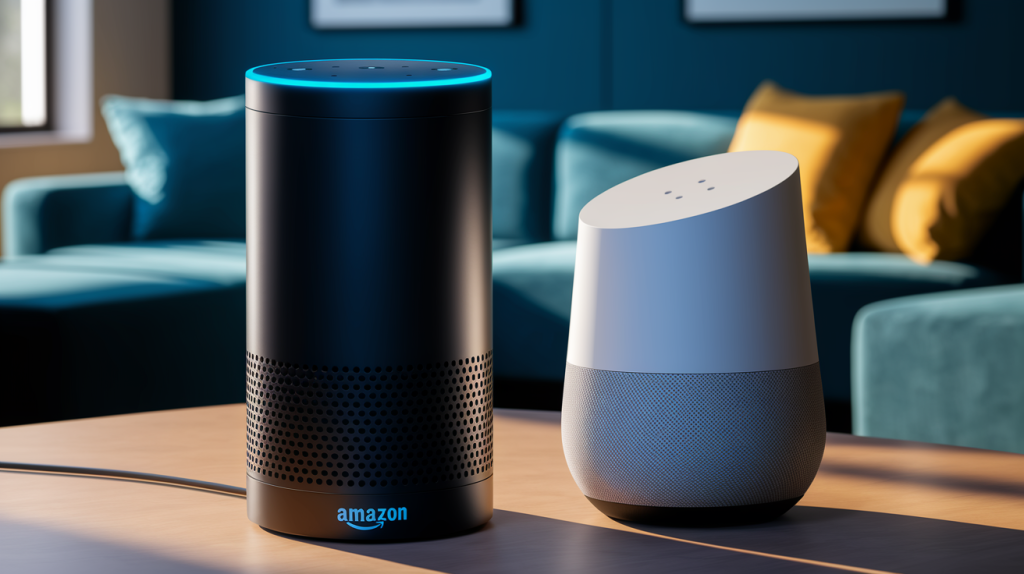
Can Google Home Outsmart Alexa in 2025?
Which smart assistant should you actually buy in 2025? Its understandable if you’ve been putting off this decision because opinions vary. I’ve spent the last month testing both Google Home and Alexa side by side in the office and at home and there are some significant differences that manufacturers don’t want to highlight. By the end of this video, you’ll know exactly which features matter for your specific situation and which assistant will actually work better in your home.
Voice Recognition: The Rock That Makes or Breaks Everything
Here’s something that might surprise you. At home I set up both assistants deliberately in the kitchen, as it’s the noisiest area in the house. The results weren’t what I expected based on the marketing claims I had read. Most tech reviewers test these devices in perfect studio conditions, but that’s not how we actually live our lives and deploy our technology. Your kitchen probably sounds like mine during peak times. Think running water, sizzling pans, maybe the dishwasher going, and family members talking (shouting) over each other. Lets not even start about 2 or 3 people all talking at once! This is where voice recognition really matters, and it’s exactly at this point where most people discover their smart assistant isn’t quite as smart as they thought.
Voice recognition accuracy forms the bedrock of any smart assistant experience, yet most reviews completely ignore real-world conditions. It sounds silly, but that’s the reality. I’ve tested plenty of tech gear over the years, and I’ve learned that lab conditions tell a false story and ultimately mislead buyers. When I decided to properly test both Google Home & Alexa, I knew I had to put them through real life testing scenarios. The question is not whether they work when you’re standing 2ft away in a quiet room – it’s whether they’ll hear you correctly when life gets real!
In this kind of real world testing 1 device consistently (and unexpectedly) outperformed the other by a significant margin. I set up both devices on my kitchen worktop and ran them through identical tests during typical dinner preparation. The noise levels varied from moderate background chatter to full family chaos, and the results were revealing.
I ran the same 20 voice commands during different noise scenarios – dishwasher running, TV on, kids playing and tracked how often each assistant heard what I said. These weren’t complex requests, just standard basic commands like setting timers, asking about weather, turning on & off a radio channel and controlling smart lights. The kind of things you’d actually use while cooking or cleaning.
Google Home’s voice recognition relies on ‘advanced neural networks’ trained on diverse accents and speech patterns, while Alexa uses a different approach with ‘far-field voice technology’ and ‘beam-forming microphones’. Google’s system processes audio through multiple layers of machine learning that can distinguish your voice from background noise more effectively. Alexa’s approach focuses on directional audio pickup, using an array of microphones to isolate sound sources. Both methods have their strengths, but they perform quite differently in challenging acoustic environments.
The real test came when I had multiple people talking simultaneously – something that happens all the time in this house but rarely gets mentioned in tech reviews. This is where most smart assistants struggle, and honestly, where I expected both to fail equally.
What I found was that Google Home correctly understood commands about 78% of the time in noisy conditions, while Alexa managed around 65%, but there’s an important caveat here. These numbers reflect my specific testing environment and speaking patterns. Your results might vary significantly depending on your home’s acoustics, your accent, and how you naturally speak to these devices.
Alexa actually performed better with certain accents and speech patterns, particularly for users who speak more slowly or have regional dialects that Google’s training data seems to miss. I noticed this when family members with different speaking styles tested both systems. Alexa showed more consistent performance with deliberate, clearly enunciated speech, while Google Home handled rapid, casual speech better. So, it’s the usual situation that we find in so many tech reviews. Theres not an outright clear winner, rather the result depends on the situation and in this case, whos using the device and how they speak to it!
The winner in voice recognition depends on your speaking style & home environment, but Google Home generally handles background noise and rapid speech more effectively. If you tend to speak quickly or your home gets genuinely noisy during peak hours, Google’s approach seems better suited to those conditions. However, if you prefer giving clear, deliberate commands and don’t mind adjusting your speaking style slightly, Alexa’s accuracy can be quite good. I fall into the latter category, so much so that at home my ‘Alexa voice’ gets mocked frequently!
Remember that the voice recognition capability is the bedrock of a digital assistant & therefore it directly impacts how well each assistant can handle the more complex features we’ll examine next.
Context & Conversation Flow: When Your Assistant Remembers What You Just Said!
I discovered something important when I asked both assistants a series of follow-up questions: 1 of them completely forgot our conversation while the other kept track like a human would. This isn’t the kind of thing you notice in quick product demos or casual testing, but it becomes obvious once you start using these devices for actual conversations rather than isolated commands. The ability to maintain context and handle follow-up questions without repeating wake words represents a major leap in making smart assistants feel natural rather than robotic. In the emerging AI world remembering context and conversing based on what has been previously discussed is a ‘big thing’. Imagine talking with a goldfish, where everything you say would be quickly forgotten. This makes it very difficult to move forward productively.
These 2 assistants handle conversational context very differently, leading to dramatically different user experiences. It’s one of those technical differences that sounds small until you actually experience it! The way each system approaches conversation flow affects everything from simple weather queries to complex smart home sequences.
I tested this by asking about weather, then following up with “What about tomorrow?” and “How about next week?” These are simple questions that should flow naturally in conversation. With one assistant, this worked smoothly. With the other, I found myself constantly wasting time (repeating information or rephrasing myself) because the device had already moved on.
Google Home excels at maintaining conversational context with its ‘Continued Conversation’ feature, allowing you to ask follow-up questions for about 8 seconds without saying “Hey Google” again. That is a massive bonus in my option. Ive always felt slightly silly exclaiming ‘Alexa’ or ‘Hey Google’ so this 8 sec window gives me enough time to think and respond naturally, much like you would in a human conversation. During my testing, I could ask about the weather, then immediately follow up with questions about different days or locations without restarting the interaction. The system understands that “tomorrow” or “next week” relates to the weather query I just made. This ability to flow is such a natural and pleasant feature.
Alexa on the other hand requires you to either use the wake word for each command or activate ‘follow up mode’, which stays listening for a few seconds but often misinterprets ambient noise as new commands. I found this to be a major problem in my kitchen test setup. Follow up mode would pick up sounds from cooking & background TV as potential commands. This led to interruptions (and then subsequent clarifications from me) where Alexa would suddenly announce it didn’t understand something no one had said, breaking the flow of whatever task I was actually trying to complete.
The real difference becomes apparent when asking complex, multi-part questions like “Set a timer for 20 minutes and remind me to check the oven, then add milk to my shopping list.”. I found that Google Assistant’s natural language processing can parse these multi-faceted ‘compound requests’ more effectively, understanding that you want three separate actions completed in sequence.
Alexa often got confused and asked me to repeat parts of the request. During my testing, it would sometimes catch only the first part of a multi-part command, requiring me to repeat the rest. Other times, it would acknowledge the entire request but only execute one or two of the actions, leaving me wondering which parts it had actually processed. This uncertainty made it feel less reliable for complex tasks. The high level of clarifying and cross-checking kind of reminds me when someone comes into the office for ‘work experience’. On paper it looks like youre getting some extra help, but in reality you end up using so much time explaining, clarifying, checking etc
I found that Google Home successfully handled roughly 85% of my follow up questions correctly, while Alexa managed only about 60% which is a big margin. However not all is lost for Alexa. It fights back with a superior ‘skills’ ecosystem that can offer more specialized conversational abilities. Within specific Alexa skills (addons), particularly those designed for games or structured interactions, the conversational flow can be quite sophisticated. Skills like interactive stories or quiz games often provide a more engaging experience than Google’s equivalent, but knowing about these skills, find and installing them is a bit of a hassle, a ‘buzz-kill’!
Google Home provides more natural conversation flow for general queries, while Alexa’s strength lies in structured interactions within specific skills and smart home routines. If you mainly use your assistant for quick information requests and casual conversation, Google’s approach feels more intuitive. However, if you rely heavily on specific third-party skills or have smart home setups with detailed routines, Alexa’s structured approach could perhaps be a more powerful option for you.
After testing both assistants extensively, the “smartest” choice isn’t about raw intelligence, it’s about which one aligns with how you actually live and communicate in your home. If you value natural conversation and have a noisy household, Google Home’s superior voice recognition and context handling make it the clear winner, but if you want the broadest smart home compatibility and don’t mind more structured interactions, Alexa’s extensive skills library gives it the edge. I did find the skills somewhat irritating though in that the skill developers all seem to choose their own language patterns to activate or use their skill. I found it a bit overwhelming to remember the exact language pattern that activated a particular skill prompting me to consider typing out a command list for the Alexa skills I was using! Overall, the real question isn’t which assistant is ‘smarter’ overall, but which one will actually make your daily routines easier and more efficient and hopefully having read this guide, you will now know which might work the best in your life.